

The moment my foot touched the ground in Quinchía, something inside me shifted—it was destiny, but only at the right time. My thoughts drifted back to when Carolina first reached out, telling me about a hidden gem of a pueblo just outside Pereira. A place I had never heard of, but one she was sure I’d love.

Quinchía, Colombia: From Hell to Heaven on Earth
Now, more than a year later, I’ve finally arrived. Not because Quinchía was ever too far or unreachable, but because life had a way of pulling me in other directions—perhaps some unseen force, or even the spirits of this ancient land, kept me away until the timing was just right.
For those with a spirit of adventure, Quinchía, Risaralda, is a hidden treasure of Colombia’s Coffee Region waiting to be explored. Whether you’re an amateur archaeologist, avid hiker, or thrill-seeker, this off-the-beaten-path destination offers giant footprints, mysterious caves, 14 rugged peaks (cerros) to conquer, and a rich indigenous history that remains largely undiscovered.

Quinchia’s beauty belies its turbulent past. Once a hotspot of the Colombian Civil War, this mineral-rich region became a battleground for three warring armed groups, each vying for control. Many locals still carry the scars—both seen and unseen—of the violence they endured.
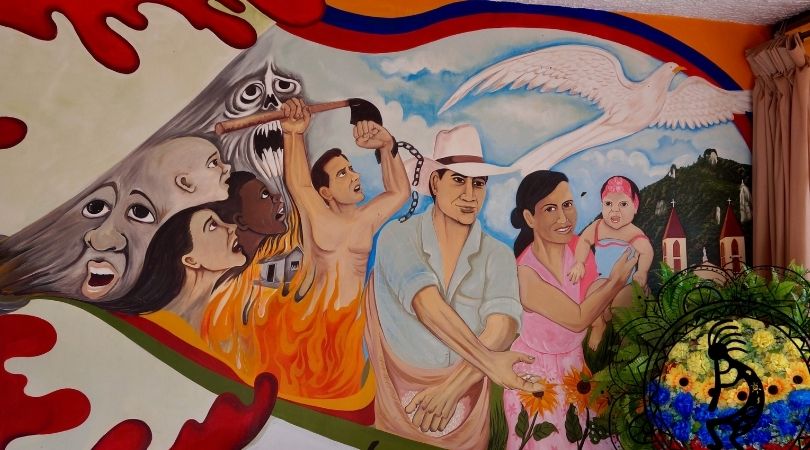
A local filigree silver artisan recounted to me his experience living through dangerous times. In the following statement he sums up his experience as:
“10 years ago we slept with our boots on, now it is a paradise.”
A local woman summed up the courage to tell me about one of her worst memories:
The people in town had all received a note slipped under their doors— a warning of a strict 6:00 PM curfew. I had just returned to the pueblo, drawn by an unshakable longing to visit. Around 5:00 PM, I heard music coming from the Casa Comunal and, curious, I went to see what was happening. Inside, children were practicing a dance, while the older ones lingered, soaking in the music.”

Suddenly, men wearing the white armbands of the Autodefensas (Self-Defense Militia) stormed in, rounding everyone up and leading them to the soccer field. The youngest children were locked inside the schoolhouse, their cries muffled behind closed doors. On the field, two well-known local laborers—both innocent—were accused of being informants or government sympathizers. Without trial or mercy, they were executed on the spot.

Next, they turned to her. She was given just five seconds to disappear. Heart pounding, she sprinted into the dense jungle, vanishing into the thick tropical undergrowth known as el monte in Spanish. Later, she would question why she had instinctively chosen that escape route—but in the end, it was the decision that saved her life.

Crouched in the dense brush, she braced for the inevitable—the moment the autodefensas would find her and gun her down. But instead, the area was suddenly engulfed by what she described as “long shadows.” As they took shape, she realized the truth—she hadn’t been found by the autodefensas. She had been found by the FARC.

A female guerrilla fighter spotted her and whispered urgently, “We’re going to put an end to this, but you need to leave—now.” Moments later, gunfire erupted.
Later, it was revealed that not two, but three armed groups had clashed in a brutal firefight, leaving a devastating death toll in their wake.
She spent the entire night hidden in the jungle, haunted by the horrors she had just witnessed. It would take years of therapy and self-healing to begin unraveling the deep trauma left by that night.

Suddenly, everything was quiet. Alvaro Uribe may not be popular (for very good reasons), in many parts of Colombia, but local residents hail him as their savior because ultimately some of his domestic policies put an end to the constant warfare and violence they had to coexist with. And Quinchia finally found peace.

Today, Quinchía is a peaceful mining town, home to four indigenous tribes and descendants of Spanish colonists. Over generations, these cultures have blended, yet many indigenous traditions remain deeply woven into daily life—evident in local greetings, banter, and unique conversational quirks.
I haven’t spent enough time here to fully capture its essence, but one thing is certain—I’ll be back!
Dive into my wild telenovela-to-truth and self-love story, master Colombian dating safely, and unlock the cultural secrets of building good friendships with locals! Get your copy of Passport to Passion for just $6.99 until Aug 31, 2025 then it goes to $9.99! https://coffeetraveler.gumroad.com/l/LoveDatingGoodLivingColombia
Giants and Artifacts
I came to Quinchía seeking adventure and history—and I found both. The town boasts a charming cultural and archaeology museum, offering a fascinating glimpse into its indigenous and colonial past. If you’re visiting, it’s well worth a stop—just keep in mind that exhibits are in Spanish only.

Quinchía boasts unique characteristics unlike anywhere else I’ve explored. It is home to several indigenous tribes, some of whom safeguard hidden sanctuaries believed to contain something extraordinary. Perhaps, with time and luck, I may one day uncover these secrets—even if their full stories remain untold for now.
What I did discover, however, was equally fascinating…
At the Casa de Cultura, I came across a book titled Historia de Guacuma, a compilation and research work by Alejandro Ugarte Rico, Merardo Largo, and Fernando Uribe. Within its pages, I found the captivating legend of El Llanto de Xixaraca:
Dicen que cuando los misioneros cristianizaron a la brava a los indigenas, el dios ancestral se retiro compungido. En el camino sus lagrimas fueron dejando huellas en las rocas y sus pies quedaron estampados en ellos, como postrer recuerdo de su existencia, cerca de la escuela de Mápura se puede observar una enorme huella, como humana, estampada en la peña y los campesinos creen oír en las noches borrascosas el eco de pisadas de seres gigantescos.
According to legend, when missionaries forcefully converted the indigenous people, the ancestral god retreated in sorrow. As he departed, his tears left imprints on the rocks, and his footprints were forever stamped into the stone—a final reminder of his existence. Near the Mápura school, a massive, human-like footprint remains etched into the rock. Locals say that on stormy nights, they can still hear the echo of giant footsteps roaming the land.

Were Giants Once in Quinchia?
Could Quinchia have been home to the Genesis 6 giants? Only fading memories, long-lost witnesses, and a few mysterious remnants hold the key to this forgotten past. Here’s what I’ve discovered so far.
Hiking Adventures at Cerro Batero
Even if ancient history and archaeology aren’t your passion, Quinchia offers something for every adventurer. With its breathtaking landscapes, rugged trails, and towering peaks, this hidden gem has left an unforgettable mark on my journey. Whether you’re a seasoned hiker or a thrill-seeking climber, Quinchia is a destination worth exploring.

Colombia abounds with these kinds of places and I couldn’t possibly see them all in my lifetime, but I can try. My favorite adventure was hiking up to the two waterfalls on the lower shoulder of Cerro Batero.
We took a Jeep out to the “Cerro Batero” vereda, and then began hiking upwards. This is not a hike for people who have any kind of knee or back problems which limit mobility.

It wasn’t terribly long, but the second half was a bit intense as we had to go up through a steep coffee field, then navigate some overgrown jungle, erosion, difficult terrain and water crossings.
Of course, the views were absolutely AMAZING! We had great weather, and I was completely in my element. The constant walking up hills in Manizales served me well in this venture.

Carolina, my guide, was so patient, kind and informative about the area. Her wanderlust has led her to explore beyond the average as she pursued what has become a lifelong passion – walking the trails of her ancestors and exploring the mountains around Quinchia.
If you plan to visit, she is my top recommended guide for the area. Yes, she does speak some English. You can contact Carolina via WhatsApp at +57 311 713 4477
Summing it all up…
I sincerely hope to be back in Quinchia again soon going where no one has previously gone, and exploring the entrance of a cave or two. The 3 days I spent were barely enough to uncover the secrets, and even then I found more than I expected to, in a place where reality is much stranger than fiction!

To learn more about my favorite destinations in the Colombian Coffee Region, click the following link:
All original photography by Erin Donaldson
If you would like to sponsor or work with me to tell a story, and explore a new place, here is my Press Kit: https://openmindedtraveler.com/press-page/
Previous Projects:


DAVID ALLEN CARR
October 15, 2020 at 9:26 pmManizales will be my new home 2nd qtr 2021. Currently 7 years living in Thailand and from Texas USA. Maybe some day soon we will meet in Manizales. Coffee anyone? I cant wait.